

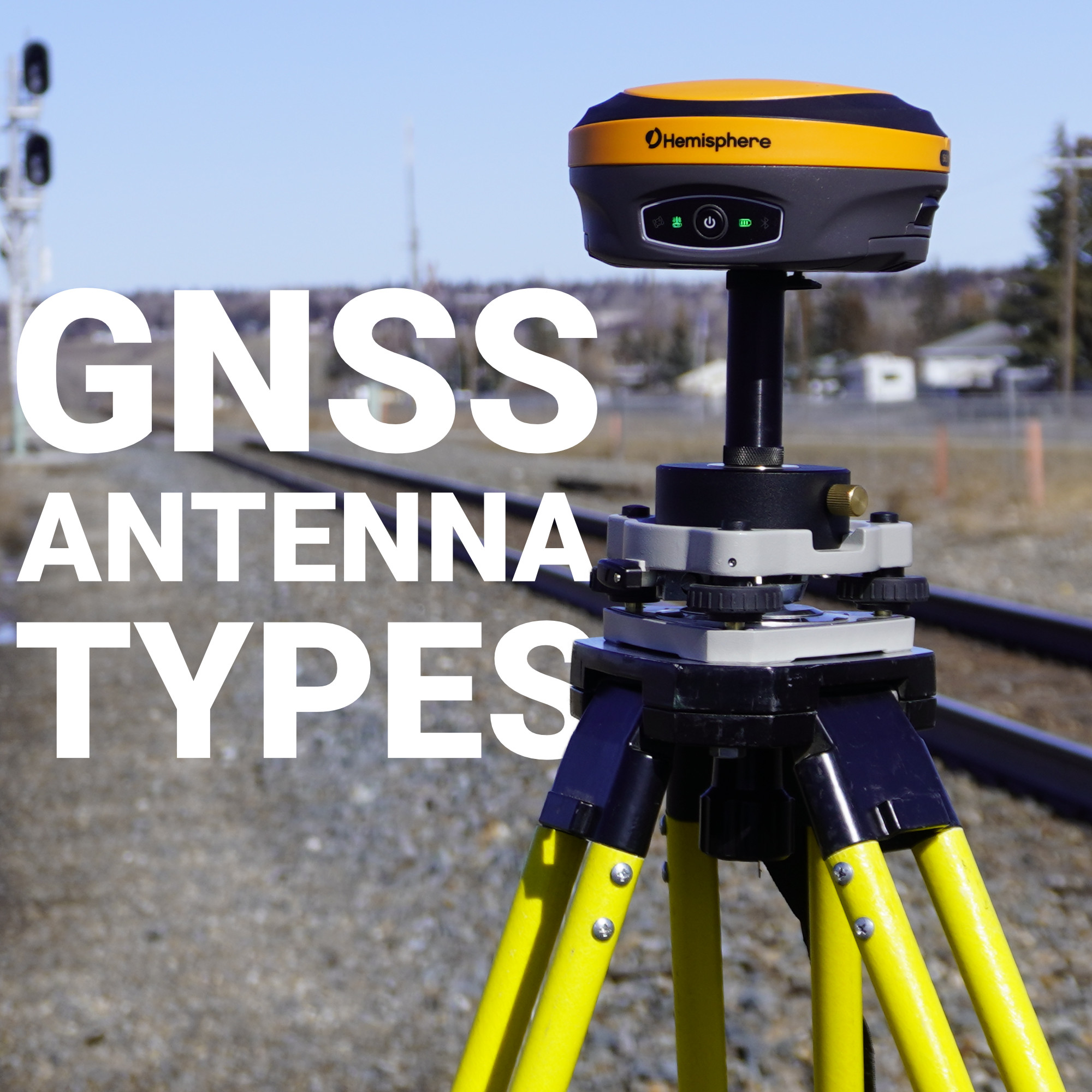
Most surveyors will happily debate receiver brands, GNSS chipsets, and correction services for hours, but the antenna sitting on top of the pole rarely gets the same attention, even though it’s the single component that decides what your receiver is allowed to “see” in the first place. Pick the wrong type and you can pair a top-tier receiver with a signal path that’s noisy, slow to fix, or simply blind to half the sky.
The good news is that once you understand the handful of categories that GNSS antennas fall into, matching one to your workflow becomes a much easier decision. This guide walks through the main antenna types on the market today, what separates them electrically, and where each one actually earns its keep in the field.
GNSS Antenna vs GPS Antenna: Clearing Up the Confusion
Active GNSS Antenna: The Standard for Precision Work
Passive GNSS Antenna: Simple, but Limited in the Field
RTK GNSS Antenna: Built for Centimeter Accuracy
Multi-Band GNSS Antenna: Why Frequency Coverage Matters
UAV GNSS Antenna: Built for Weight, Not Just Performance
GPS/GNSS Smart Antennas: All-in-One Convenience
Getting the Match Right
The terms get used interchangeably online, but they’re not the same thing. A GPS antenna is tuned specifically to the U.S. GPS constellation. A true GNSS antenna is multi-constellation, built to track GPS, GLONASS, Galileo, and BeiDou signals at the same time.
In practice, this isn’t just a marketing distinction, it changes how many satellites your receiver has to work with at any given moment. More visible satellites means faster fixes, better geometry, and more resilience when part of the sky is blocked by tree canopy, buildings, or terrain.
Every GNSS antenna can technically pick up GPS signals, but not every GPS-labeled antenna can handle the full multi-constellation load. For any professional survey work in the U.S. today, a full GNSS antenna is the only real option worth considering.

An active GNSS antenna includes a built-in Low-Noise Amplifier (LNA) that boosts the incoming satellite signal before it ever reaches the receiver.
Active GNSS antennas include an integrated Low-Noise Amplifier that boosts the signal before it’s passed to the receiver, along with front-end filtering that removes out-of-band noise to improve signal quality.
That amplification matters because the use of an active antenna is generally advisable whenever the RF cable between the receiver and antenna runs longer than about 10 cm, which describes nearly every pole-mounted survey setup. The tradeoff is that active antennas need power, typically fed through the same coax cable from the receiver. This is a non-issue for RTK rovers, but it’s a detail worth knowing if you’re building a custom setup.
A passive GNSS antenna is the stripped-down version, just the receiving element, with no amplification and no power requirement.
A passive GPS antenna consists only of the antenna element, receiving signals and passing them directly to the receiver with no amplification. That simplicity keeps costs low and eliminates power draw, but it comes at a price: passive antennas only perform well when the cable run is short and the signal environment is clean.
For land surveying, where receivers are often mounted on poles well away from any short, direct cable run, passive antennas are rarely the right call. They’re more common in embedded consumer electronics than in professional RTK equipment.
An RTK GNSS antenna is a purpose-built, high-precision antenna designed to work alongside real-time kinematic correction data. These aren’t general-purpose antennas, they’re engineered around a few critical parameters:
This is the category that receivers like the Hemisphere S631 fall into, and it’s the reason two antennas that look nearly identical on the outside can produce very different results in a real RTK network. At Bench-Mark, this is the category we get the most questions about, since even experienced crews sometimes assume “any GNSS antenna” will do once the receiver itself is dialed in.

A multi-band GNSS antenna tracks more than one frequency per constellation, commonly L1, L2, and increasingly L5, rather than locking onto a single band.
This matters because dual- and triple-frequency tracking allows the receiver to resolve ambiguities faster, filter out ionospheric error more effectively, and hold a fix longer under partial obstruction. If your receiver is capable of multi-frequency positioning, pairing it with a single-band antenna effectively throttles its performance.
Before buying, always confirm your antenna’s supported bands line up with what your receiver and data collector, such as FieldGenius, are actually configured to use.
A UAV GNSS antenna faces a different set of constraints entirely. On a drone, every gram affects flight time and stability, so these antennas are built to be as light and low-profile as possible while still delivering multi-band, multi-constellation tracking.
Vibration resistance and a stable phase center under motion are also critical, since UAV antennas are constantly moving rather than sitting still on a fixed pole.
Some UAV-specific antennas also include tighter filtering to reject interference from the drone’s own onboard electronics, a problem that ground-based antennas rarely have to deal with.
A GPS/GNSS smart antenna combines the antenna element, LNA, and a full GNSS receiver into a single integrated housing, rather than requiring a separate receiver connected by cable.
This design simplifies installation for machine control, marine, and asset-tracking applications where a compact, weatherproof, single-unit solution is preferable to running cables between separate components.
The tradeoff is flexibility: smart antennas are generally purpose-built for a specific application and don’t offer the same mix-and-match compatibility as a standalone RTK GNSS antenna paired with a separate receiver.
A few practical rules of thumb can shortcut the decision:
The right antenna won’t show up as a line item you notice day to day, it shows up in faster fixes, fewer dropouts, and data you can trust without a second thought. Bench-Mark works with crews across the U.S. to match GNSS antennas to their actual receivers and workflows, rather than defaulting to whatever’s cheapest or most generic on the shelf, because the wrong pairing quietly costs more in redone shots than it ever saves upfront.
Treat the antenna with the same scrutiny you’d give the receiver itself, and the rest of your RTK setup has a much better chance of performing the way it’s supposed to, fix after fix, job site after job site.
