

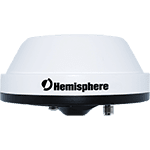
The Hemisphere C631 stands as the latest breakthrough receiver in Hemisphere GNSS’s product lineup, purpose-built for the rigorous demands of the construction industry. Featuring the state-of-the-art Phantom P40 board, meticulously engineered to harness the full potential of all available satellite constellations and signals, the C631 excels in challenging construction environments, making it a top performer in its class. When combined with the 60° tilt sensor, this receiver becomes the go-to solution for construction professionals who need precision and versatility on the job site.
Hemisphere GNSS has earned a stellar reputation for delivering high-performance, high-precision, and reliable GNSS positioning solutions at a competitive price point. Their product design philosophy emphasizes ease of integration and staying up-to-date with the latest satellite signals and constellations. With one of the most advanced RTK and positioning engines available, the Hemisphere C631 empowers construction teams to tackle projects in previously hard-to-reach locations and to conduct accurate surveying, grading, and site preparation. This receiver embodies Hemisphere’s commitment to providing construction professionals with the tools they need to achieve unparalleled precision and efficiency, ultimately elevating construction site performance and project outcomes.

"*" indicates required fields
Product details
Package includes
The Hemisphere C631 is a multi-frequency, multi-constellation GNSS receiver designed for professional surveying and construction workflows. It can support topographic surveys, site layout, construction staking, grading, and other field tasks that require precise positioning.
A base-and-rover setup uses one receiver as a base station and another as a mobile rover. The base transmits RTK corrections to the rover, allowing it to calculate precise positions without relying on a third-party network correction service. A single receiver can be suitable for network RTK work when configured to receive corrections from a compatible service.
The C631 is designed for centimeter-level positioning when receiving reliable RTK corrections. Hemisphere’s specifications list RTK positioning performance of 8 mm + 1 ppm RMS and 15 mm + 2 ppm at 2DRMS. Actual results depend on baseline length, satellite geometry, multipath interference, and correction quality.
The product listing advertises an internal 1-watt Satel radio with a range of up to 10 km (6.2 miles) between the base and rover. Actual range can vary with terrain, obstructions, antenna placement, interference, and other site conditions, so the maximum advertised distance should not be treated as a guarantee.
Yes. When configured as a local base-and-rover system, the receivers can exchange RTK corrections over their radio link without requiring cellular data or an internet connection. Network RTK generally requires a suitable internet connection, while Hemisphere’s Atlas satellite correction service offers another option where a compatible receiver configuration and active subscription are available.
Yes. The C631 supports RTK corrections through several communication methods, including radio and network connections. It is also Atlas-capable, allowing it to receive satellite-delivered corrections through a paid subscription without depending on a nearby base station or cellular network. The appropriate correction method depends on your coverage, accuracy requirements, and selected configuration.
The receiver has an internal sensor that helps compensate for a tilted survey pole, reducing the need to keep the pole perfectly vertical at every measurement point. This can make point collection more efficient around obstacles and in construction environments. Reliable results still depend on the receiver maintaining a suitable positioning solution and being used within its supported tilt limits.
The product listing advertises up to 9 hours of operation and specifies hot-swappable batteries, allowing a battery to be replaced without shutting down the receiver. Actual runtime depends on operating mode, radio usage, and field conditions, so carrying charged spare batteries is advisable for longer workdays.
The C631 has an IP67 environmental rating and is designed to withstand demanding field conditions. Manufacturer specifications also reference MIL-STD-810G shock resistance and a design intended to survive a 2 m pole drop onto concrete. Even with this rugged construction, using the receiver within its environmental limits and following proper handling procedures remains important.
The product page lists a UHF antenna, two batteries, a charger and cables, a car charger, and a hard case alongside the selected C631 receiver configuration. The quote form allows buyers to choose a base-and-rover or single-receiver setup, as well as data collection and accessory options. Confirm the selected configuration and component quantities in the final quote before ordering.


Reviews
There are no reviews yet.