

Selecting land surveying instruments is ultimately a business decision. These tools determine the accuracy of your deliverables, the efficiency of your crews, and the return on investment for every project you take on. Unlike consumables or short-term rentals, instruments often remain in service for years.
The difficulty is that the landscape of equipment is no longer straightforward. Traditional optical tools remain essential in certain contexts, but GNSS receivers now dominate most large-scale projects.
This guide is intended to provide clarity. We are going to outline the primary categories of surveying instruments, their appropriate applications, and the considerations that should inform a purchasing decision.
Why Land Surveying Instruments Matter
The Core Instruments Every Surveyor Should Know
How to Decide What You Really Need
Factors to Consider Before Buying
Care and Longevity of Your Instruments
A Short List of Buyer Tips
Final Thoughts
Surveying is the foundation of modern infrastructure. Roads, subdivisions, pipelines, environmental studies, and property boundaries all rely on accurate measurements. A small error in the field can result in costly redesigns or disputes.
Land surveying instruments do three critical things:
When you match the right instrument to the right project, you reduce risk and maximize productivity. When you don’t, you risk inconsistent results, frustrated crews, and wasted investment.
The land surveying toolbox has expanded dramatically in the last 20 years. Still, each instrument has a place.
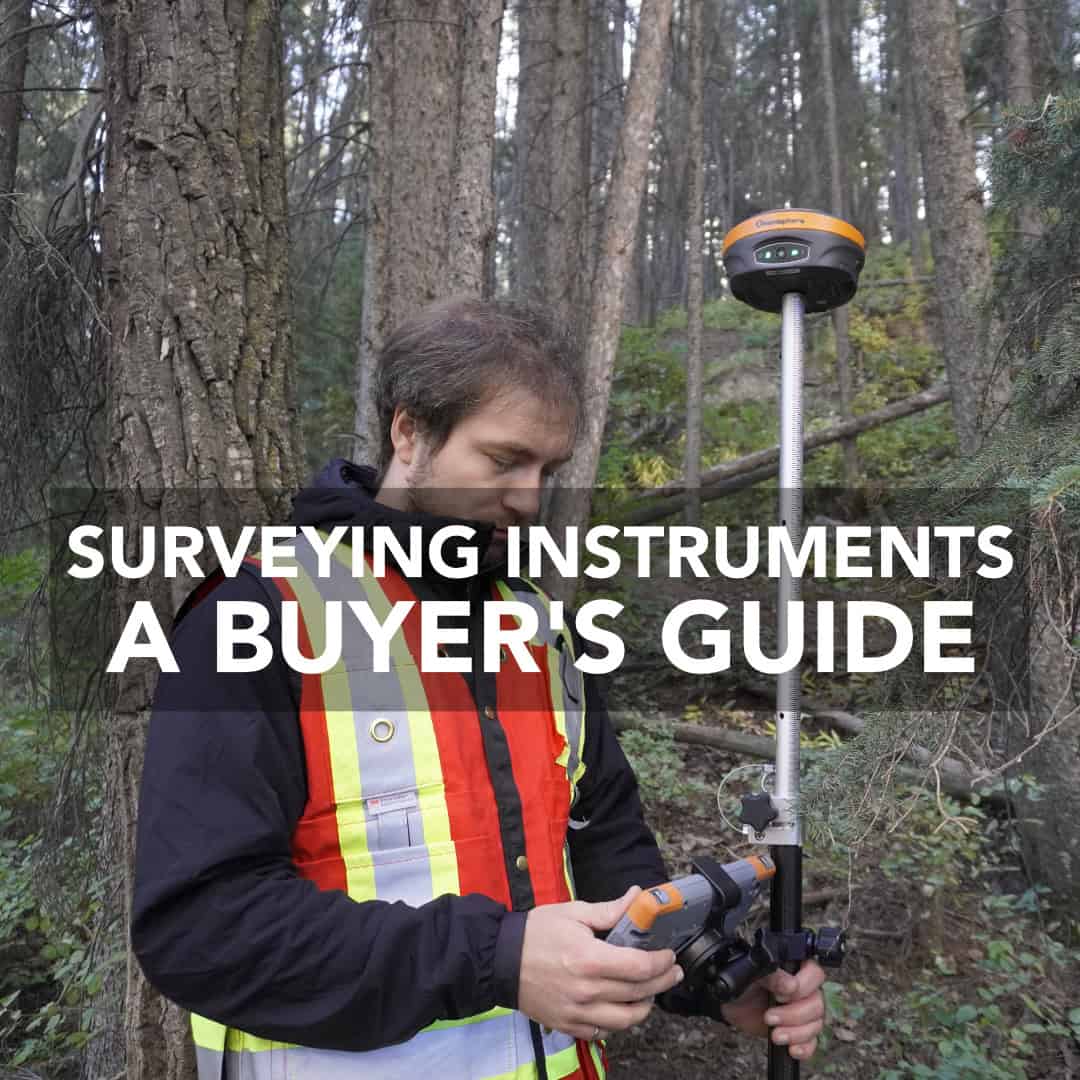
Real-Time Kinematic (RTK) GNSS is the backbone of modern surveying. These receivers use satellite corrections to provide centimeter-level accuracy in real time, even across large sites. For many surveyors and engineers, RTK is the first purchase and often the only tool they use daily.
Our top-seller, the Hemisphere S631, delivers rugged performance at a price point far below the traditional big three (Trimble, Leica, Topcon). For professionals, this class of GNSS receiver is where the industry has shifted.
Despite GNSS dominance, total stations still play a role. In areas with canopy cover, urban canyons, or tunnels, satellites simply don’t reach. Robotic total stations like the GeoMax Zoom95 offer excellent precision, especially for boundary surveys and construction layout.
Surveyors often maintain both RTK and total stations, choosing between them depending on site conditions.
The humble automatic or digital level remains a staple for elevation checks. On large construction sites, contractors still rely on levels for quick, repeatable measurements where GNSS would be overkill.
3D scanners and imaging solutions have become more common, particularly for engineering and monitoring projects. They are not always cost-effective for small firms, but scanning fills the gap when dense point clouds and visual records are required.
Not every professional needs the full suite of land surveying instruments. In fact, overbuying equipment is one of the most common mistakes we see at Bench-Mark. Instead, start with your projects and workflows:
When evaluating land surveying instruments, professionals should think beyond just the spec sheet. A receiver with a 40-hour battery life might look appealing, but if the software is clunky or support is limited, that advantage disappears quickly. Some key considerations are:
One of the biggest differentiators in the US market is support. Many regional dealerships tie customers into a single brand with limited flexibility. At Bench-Mark, we prioritize open, compatible solutions and provide ongoing online and phone-based support across North America.
Even the best land surveying instruments need care to perform reliably. Daily habits matter: keep lenses clean, check calibration, and store equipment in padded cases. For GNSS receivers, updating firmware and managing batteries can extend lifespan significantly.
Annual servicing, either through the manufacturer or a trusted vendor, ensures accuracy stays within spec. Think of it like a vehicle: the upfront purchase is only part of the cost. Maintenance determines whether your investment pays off over five years or fails in two.
To make sure you get the right fit for your work, keep these essentials in mind:
The world of land surveying instruments is changing fast. Professionals now have a broader set of options, where they can choose cost, compatibility, and accuracy. For many US-based surveyors, civil engineers, and construction crews, RTK GNSS has become the basis of their workflow, supported by total stations, levels, and specialty tools when conditions require.
At Bench-Mark, we help professionals navigate these choices daily. Our goal is to provide tools that match your work. When you invest in the right land surveying instruments, you invest in efficiency, accuracy, and the success of every project you put your name on.
