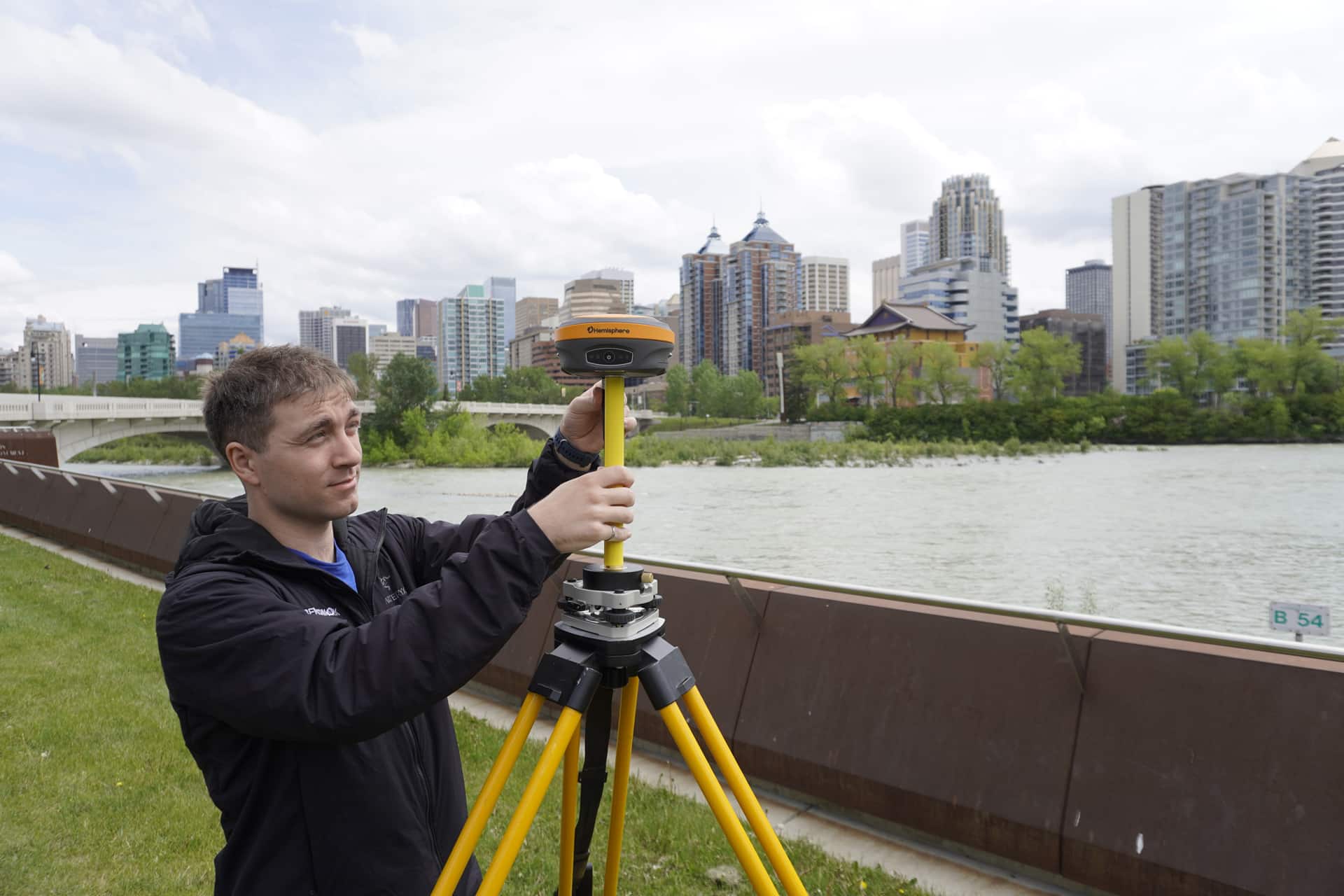
Originally, before the advent of RTK, recording a static position with an GPS system was the only way to obtain an accurate position. This was before the days of UHF and Network subscriptions. The position had to be derived from an average of measurements collected over a set time interval. Things have obviously changed greatly since those days, but static still fulfills an important role in surveying. There are a range of applications where static GNSS surveys are deployed, from rapid static surveys to continuously operating reference stations to establishing benchmarks.
Although on the surface, taking a static position appears to be simple especially when compared to RTK surveys, there are many different variables to consider. Understanding the pitfalls of what can go wrong during a static survey means that you can avoid costly mistakes, which, due to long occupation times, can waste a lot of your time.
Before launching into what you have to avoid during a static survey, let us look at when it makes sense to record static data.
| Survey Type | Advantages | Disadvantages |
| Real-Time Kinematic (RTK) | Real-Time corrected positions in a known coordinate plane. Able to navigate and compute points live in the field. | Requires investment in base station, or network subscription. Must have radio or cell connection to the base. More expertise required to run software. |
| Post-Processing Kinematic (PPK) | Reduced logistics, cost and complications. Sufficent for most nonengineering surveys. | Corrected data is not available until processing is complete. Necessary to set base at benchmark or set its location later. |
| Rapid Static | Reduced Equipment expense comapred to other techniques. No local base station is required. | Requires longer occupation times up to 2 hours, reducing efficency. Lower accuracy than PPK or RTK |
| Static | Higher precision than rapid static, less equipment than RTK or PPK | Requires long occupation time to acheive the same accuracy as PPK or RTK. |
Static GPS techniques remain irreplaceable in several high-precision and scientific surveying applications. Despite advances in RTK and PPK, static survey methods continue to be the preferred approach in scenarios where accuracy, stability, and long-term reliability are important.
Static GPS GNSS provides the highest possible precision because long observation windows minimise error and increase solution reliability. It’s indispensable even in a world dominated by real-time methods.
Many of the following tips may be common knowledge to a lot of you, but it is never a bad idea to have a quick refresher. The first thing to check before beginning a static survey is your equipment. This may seem trivial and pointless, but it is the most common mistake we see. Make sure your batteries are charged, your tripod is in good condition and that you know how to setup the static record. It may seem obvious, but you would be surprised how many people phone us in the field who do not know how to use the equipment.
The next thing to do, and although less important than it once was, is to mission plan. Take a look at the sky plot, and see when there is the largest number of satellites are in your area. It may seem trivial with the number of signals and satellite constellations available to modern day GNSS receivers, but it can still save you time by doing this. The more satellites present, the better the data you can collect, and the better the position you can resolve.
Finally, you should check in on the position you plan to record at. Is the area free of obstructions? Are there any objects that could introduce multipath interference into the equation? Objects like buildings and trees can increase the uncertainty in the measurement. It may not always be possible to optimize your position but all efforts should be taken to make this possible.
The last thing to check before beginning a static session, are your receiver settings. It is important to ensure that your settings are optimized for the equipment you are using, and for the finished product you desire. For the S631 we recently put that to the test. Check it out here.
To quickly summarize the results here, for quick occupation times you want your record rate to be faster and for shorter occupation times a slower data record rate should be used. From the tests we performed, for an occupation time of 15 minutes, a 5 Hz record rate should be used. For longer occupation times over 1 hour, a record rate of 15 seconds should be used.


To give some background on the test, we took the same receiver and set it over the same point outside of our office at 11 am MST. The record rate was then set and data recorded for a set time frame of 15, 45, 120, or 240 minutes. The captured data was then put through the Hemisphere Rinex Convertor V. 2.0.3.0, and sent off to NRCANs PPP service. This is by no means a scientific analysis of the receiver settings, but it should give you a good idea on what you should be doing in the field.
The last thing to check before beginning a static session is your receiver’s data recording settings. Optimizing the record rate is essential for balancing survey duration, accuracy, and dataset size. We recently tested this on the Hemisphere S631. Here are the key takeaways:
Short static survey sessions depend on high-frequency sampling to resolve errors quickly. Longer static sessions benefit from spaced-out measurements because noise and multipath effects average out over time.
We set the same receiver over the same point outside our office at 11 AM MST and recorded data for 15, 45, 120, and 240 minutes. Each dataset was processed through the Hemisphere RINEX Converter (v2.0.3.0) and submitted to NRCAN’s PPP service. While not a laboratory-grade analysis, these results provide meaningful field insight for everyday use.
Bench Mark Equipment & Supplies is your team to trust with all your surveying equipment. We have been providing high-quality surveying equipment to land surveyors, engineers, construction, airborne and resource professionals since 2002. This helps establish ourselves as the go-to team in Calgary, Canada, and the USA. Plus, we provide a wide selection of equipment, including global navigation satellite systems, RTK GPS equipment, GNSS receivers, and more. We strive to provide the highest level of customer care and service for everyone. To speak to one of our team today, call us at +1 (888) 525-7538 or email us at [email protected]