

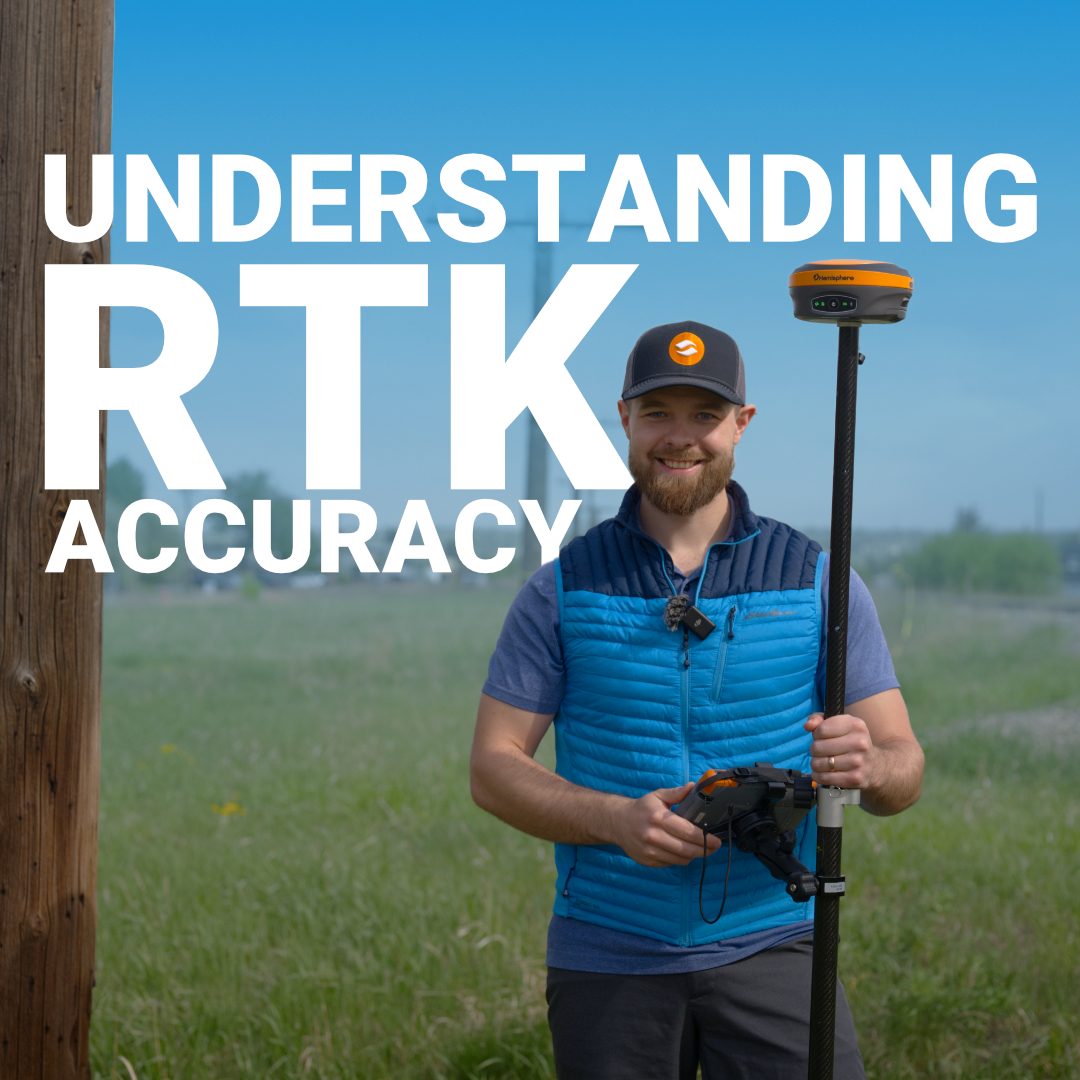
GNSS stands for Global Navigation Satellite System, and it’s the umbrella term for all satellite positioning networks. GPS is just one piece of it, the U.S. constellation. When your receiver tracks GPS, GLONASS, Galileo, and BeiDou simultaneously, you’re using GNSS.
The advantage is simple: more satellites visible at any moment means better geometry and stronger positioning solutions. In obstructed environments, under bridge decks, near buildings, or in tree cover, GNSS receivers maintain lock where GPS-only units drop out.
Standard GNSS positioning, often called “autonomous” mode, gets you 2-10 meter accuracy. That’s fine for navigation, fleet tracking, or general asset management. It works anywhere on Earth, requires no base station, and operates independently. For many applications, that’s all you need.
How RTK Changes the Accuracy Game
Why the “GNSS vs RTK” Framing Misses the Point
When Autonomous GNSS Makes Sense
When RTK Becomes Essential
The Real Costs and Tradeoffs
PPP and Network RTK: The Middle Ground
Environmental Factors That Affect Both
What You Actually Need to Know
Getting RTK Right from the Start
Match the Tool to the Job
RTK (Real-Time Kinematic) is a correction technique applied to GNSS signals. It doesn’t replace GNSS, it refines it to centimeter-level accuracy by using a base station at a known location.
Here’s how it works: the base station receives the same satellite signals as your rover. Since the base knows exactly where it is, it calculates the error in those signals and broadcasts corrections to your rover in real time. The rover applies those corrections and locks onto a precise position, typically within 1-2 centimeters horizontally and 2-3 centimeters vertically.
The catch is proximity. RTK corrections degrade with distance from the base. Most manufacturers recommend staying within 10-20 kilometers for reliable centimeter accuracy, though newer multi-frequency systems like the Hemisphere S631 can push that range further in good conditions.

You’ll see articles and product pages treat GNSS and RTK as competing options. That’s misleading. Every RTK system is a GNSS system. The real comparison is between autonomous GNSS (no corrections) and RTK GNSS (real-time corrections).
When someone says they’re choosing between “GNSS or RTK,” what they usually mean is: do I need centimeter accuracy, or will meter-level positioning work? The decision isn’t about technology type, it’s about workflow requirements, budget, and field conditions.
Use standard GNSS when accuracy requirements sit in the 1-10 meter range and you need global coverage without infrastructure. Common applications include:
The biggest advantage is simplicity. No base station to set up, no radio or cellular link to maintain, no range limitations. You turn on the receiver and go. For contractors doing layout checks, environmental monitoring in backcountry, or preliminary site walks, autonomous GNSS delivers reliable positioning without the complexity.

RTK is non-negotiable when your work demands centimeter-level precision and you can’t afford errors that compound across measurements. Survey-grade work, construction staking, precision grading, and boundary surveys all require RTK.
Real-world scenarios where RTK justifies the added complexity:
RTK GPS systems deliver immediate results. You stake a point, mark it, and move on, no post-processing required. That real-time workflow is what separates RTK from post-processed kinematic (PPK) techniques, where you collect data and correct it later in the office.
RTK setups cost more than autonomous GNSS, but the gap has narrowed. A couple of decades ago, RTK meant $100,000+ systems from Trimble or Leica. Today, you can get RTK-capable receivers for a fraction of that, though you still need to account for the base station or a correction service subscription.
Here’s what the investment actually includes:
For high-volume survey work, RTK pays for itself in productivity. You’re not returning to post-process or re-surveying questionable points. For occasional precision work, consider a hybrid approach: run autonomous GNSS for general mapping and switch to RTK when accuracy matters.

Two other correction methods sit between autonomous GNSS and traditional RTK: Precise Point Positioning (PPP) and Network RTK.
PPP uses satellite-delivered corrections instead of a local base station. It can achieve 5-10 centimeter accuracy globally without infrastructure, but initialization takes 10-30 minutes. That makes it practical for static control points but less useful for RTK-style roving.
Network RTK connects to a regional network of permanent base stations (often called CORS). Instead of running your own base, you pull corrections from the nearest station via cellular or internet. Coverage is excellent in developed areas, but you’re dependent on network availability and subscription fees. For surveyors working across large territories, network RTK eliminates the need to haul a base station between jobs.
Whether you’re running autonomous GNSS or RTK, environmental conditions impact performance. Obstructions, multipath, and atmospheric interference don’t discriminate.
RTK doesn’t magically fix multipath or poor satellite geometry, it corrects for atmospheric delay and clock errors. If your rover is surrounded by reflective surfaces or heavy canopy, RTK still struggles to maintain a clean fix. That’s where antenna quality, receiver processing power, and multi-frequency tracking (L1/L2/L5) become critical.
The Hemisphere S631 and similar modern receivers handle challenging environments better than older single-frequency units, but no RTK system works miracles when satellite visibility drops below four or five birds with good spread.
Forget the “GNSS vs RTK” comparison. Every RTK setup uses GNSS. The real question is whether you need the precision RTK delivers and whether your workflow supports the added complexity.
If you’re staking property corners, controlling grade, or building as-builts, RTK is the standard. If you’re tracking equipment locations, doing reconnaissance mapping, or working in areas where base station setup isn’t practical, autonomous GNSS gets the job done.
Most modern GNSS receivers, like the systems we sell, support both modes. You’re not locked into one approach. Run RTK when accuracy matters, and switch to autonomous mode when it doesn’t. The flexibility matters more than the specs.

RTK accuracy depends on more than just buying a good receiver. Your base station location, antenna setup, and correction delivery all affect field performance.
Mount your base on stable ground with clear sky view. A wobbly tripod or partial obstructions introduce errors that propagate to every rover position. Use a ground plane or choke ring antenna to minimize multipath at the base, that clean reference signal is what makes RTK work.
For the rover, integrate your antenna properly. Pole height, bubble level, and cable quality all matter. Even the best RTK receiver paired with a cheap antenna or poorly centered setup delivers mediocre results. If you’re running FieldGenius, make sure your antenna model is correctly entered so phase center offsets apply automatically.
RTK isn’t a replacement for GNSS, it’s a refinement technique that trades simplicity for precision. When centimeter accuracy justifies the cost and complexity, RTK is unmatched. When meter-level positioning works fine, autonomous GNSS keeps you moving without the overhead.
The best survey setups aren’t built around one mode. They adapt. You run RTK for control and layout, autonomous GNSS for reconnaissance, and PPP or network RTK when traditional base setups don’t fit the project. Understanding when each approach makes sense, and why they’re all built on the same GNSS foundation, puts you in control of accuracy, efficiency, and budget.At Bench-Mark, we’ve helped surveyors and contractors across North America configure RTK systems for everything from boundary surveys to highway construction. Whether you’re upgrading from autonomous GNSS or building your first RTK setup, we can walk you through the equipment, corrections, and integration that fit your work. Because precision isn’t just about the receiver, it’s about the whole system working together.
